Malcolm Le Grice’s Horror Film

This week, in London, I met up with Malcolm Le Grice. Recently, we’ve been pondering how it might be to tackle the re-enactment, or recreation of his Horror Film, from 1971. The piece, for three 16mm projectors, involves a live performer, naked, with his back to the audience. He begins right up near the screen, and during the course of the performance, moves slowly backwards until he reaches the projectors.

I’ve never seen the work performed live, so most of my speculation here is based on video documentation, my imagination, and my experience of working with other expanded cinema projects.

le grice horror film stills
[some representative stills from Horror Film, thanks to the LUX website.]

All the while, the performer makes a series of movements with his hands, arms, shoulders, seeming to feel the boundaries of the projected rectangles of light. The performer’s body-shadows are crucial to the work, and it seems that these shadows, which loom larger and larger as the piece goes on, are what gives it the feeling of an old fashioned “horror” movie. (Some discussion of the use of shadows in horror films here.)

During Malcolm’s Horror Film, the sound of breathing is audible, amplified in the room. Presumably, this is the live microphone link-up of the performer’s own breath while in action (or it may be pre-recorded).

It’s a seemingly simple work. With a bit of practice, and a strong attention to precision, there’s no reason it couldn’t be performed by anyone. I can’t see that it’s necessary for the performer to be male, either.

As for the medium-specificity side of things – how essential is it that the piece is projected from 16mm film? The film strips seem to be large lush blocks of colour, which project over the top of one another. When the performer’s body gets in the way, the shadows allow additive/subtractive colour combinations to emerge.

This is a punt (I’ve not researched it at all yet): the colour 16mm strips might have been made through a ‘pure’ process, using light exposure onto the celluloid without a camera, and cross-processed (not sure of the correct term) in some way on the London Film-Maker’s Co-op’s developing machine.

Would the process of re-creating this work involve following similar photo-chemical procedures to manufacture new 16mm strips?

Or, would it involve making similar colour sequences, using video instead?

And what about the projection event? What is essential to the event about film-versus-video? The central projected image seems to be white. Does that mean the central 16mm projector was actually empty of film? Ie – just the direct light from the projector bulb running through a lens. If so, how can an equivalent whiteness be produced by a colour video projector (which uses a combinatory light system to ‘produce’ white).

In our meeting, Malcolm and I spoke about issues to do with medium authenticity. In general, he’s not particularly concerned with staying true to the original medium, preferring to be pragmatic about what is currently available, and easier to use. I tend to agree – however, it could be interesting in Horror Film, to try a ‘compare and contrast’ approach (making a film and a video version) for the purposes of looking into how each of these generates a different kind of experience. (Other matters to consider include issues like the “presence” of the projectors in the room, and the sounds they make – video has a very different feel).

Malcolm’s ideas about media were very stimulating. He talked about his notion of ‘discourse’ rather than medium, to describe our experience of the digital world. I’ll be interested to read more about that, and I’m sure when we get a chance to work more closely on Horror Film, we’ll also delve more deeply into live experience and ‘present-ness’ – two areas which we both agree are at the core of the sort of thing which makes expanded cinema what it is.

-Lucas

TLC’s Anthony McCall project in Perform Repeat Record

perform repeat record

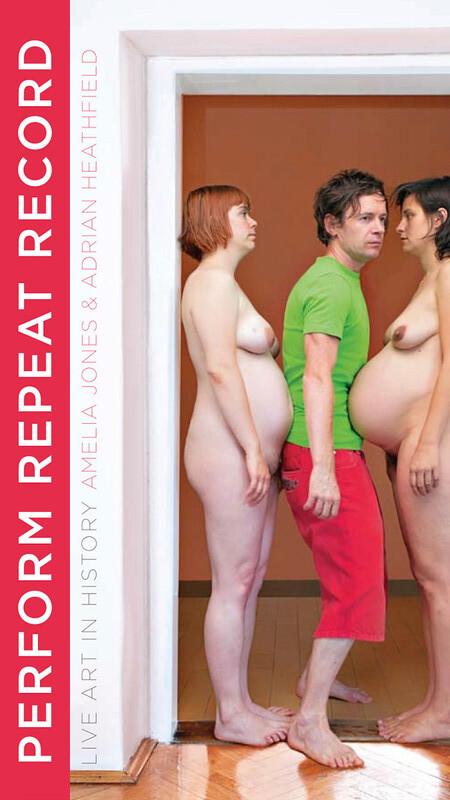
A chapter I wrote about our 2007 re-enactment of Anthony McCall’s Long Film for Ambient Light has been included in the book Perform Repeat Record: Live Art in History, edited by Amelia Jones and Adrian Heathfield.

You can check out the book here.

Louise Curham and I were really pleased to be involved in this publishing project, which places the work that we are doing with “researching Expanded Cinema via live action” alongside many other attempts by artists and curators to revisit performative works of the recent past.

A review, written by Caroline Wake, was published in Realtime.

You can read the chapter as a pdf file here.

-Lucas Ihlein

Re-Enacting Expanded Cinema: Three Case Studies

In 2009, Lucas Ihlein and Louise Curham presented a paper at the Re-Live Media Art Histories conference in Melbourne.

There seem to be some problems accessing the proceedings online, so we’re posting the paper here on our own website in the spirit of collegiality.

It’s entitled Re-Enacting Expanded Cinema: Three Case Studies.

Here’s the abstract:

Since 2003, the practice of Sydney’s Teaching and Learning Cinema has involved the re-enactment of Expanded Cinema performances from the 1960s and 70s. As artists, we have discovered that direct access to the work of our aesthetic precursors is essential for understanding, and building upon the work of the past.

However, since many Expanded Cinema events were ephemeral and situated in time and place, they do not easily lend themselves to documentation and archiving. As a result, the works are poorly represented in art history. Re-creating them in our own ‘here and now’ is a creative pedagogical process, in which the works become available once again for first-hand experience.

Clearly, these re-creations are not ‘authentic’ or ‘correct’ – rather, the very concept of authenticity and the integrity of the bounded art event are brought into question by this unique form of practice-based research. In this paper, we touch on three three Expanded Cinema works we have re-created – William Raban’s 2’45” (1973); Anthony McCall’s Long Film for Ambient Light (1975) and Guy Sherwin’s Man with Mirror (1976).

We discuss the dilemmas that emerge from such a process. Geographical distance, cultural context and technological developments all make significant demands on the resourcefulness and wit of the re-enactors. Emerging from this process, our re-enactments generate an organic living history, in which the works are ‘kept alive’ through the practice of passing them from one generation to the next.

You can download the pdf of the paper here.


PS: Some of my earlier thoughts on re-enactment as a strategy are here.

Xavier Garcia Bardon’s essay on “Man with Mirror”

xavier garcia bardon essay clip

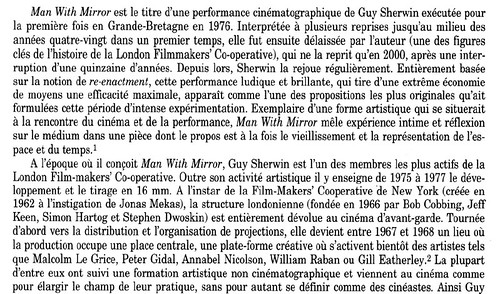
Xavier Garcia Bardon, a film curator from Brussels, has written a book chapter all about Guy Sherwin’s Man with Mirror.

Excitingly (for us), his essay also includes a consideration of Louise Curham and Lucas Ihlein (Teaching and Learning Cinema)’s re-enactment/extension of Sherwin’s piece, entitled(Wo)Man with Mirror, which was first performed in 2009.

Xavier’s chapter is in the following book:

Philippe DUBOIS, Frédéric MONVOISIN, Elena BISERNA (ed.), Extended Cinema. Le cinéma gagne du terrain, Campanotto Editore, Pasian di Prato, 2010. ISBN: 88-456-1171-1

With Xavier’s permission, we’ve posted a link to the pdf of his chapter here.

It’s in French. If anyone can do a translation for us, we’d be eternally grateful.

Malcolm Le Grice Screening in Sydney

Moving Image Art
by Malcolm Le Grice
at Performance Space, Carriageworks,
245 Wilson Street, Everleigh NSW 2015.
Friday 5th November
6 – 8pm

Malcolm Le Grice will introduce a program of films and video, from 1 to 16 mins in duration, made between 1966 and 2009. Malcolm Le Grice started as a painter but began to make film and computer works in the mid 1960’s. He was a founding member of the London Filmmakers Co-operative and has made works collaboratively with other artists and performers including Brian Eno.

Program to include:

Little Dog For Roger, Wharf, Horror Film 1 documentation, Berlin Horse (sound with Brian Eno), Again Finnegan, For the Benefit of Mr K, Unforgettable, Beware, Critical Moment, Threshold, Neither Here Nor There, After Monet, Digital Aberration.

On the following day, Saturday 6th November, an associated event, Expanded Architecture – International Architecture Film Night.

Australian International Experimental Film Festival launched

Excitement!

Sue K & the Nanolab gang have announced their collaboration in presenting the Australian International Experimental Film Festival http://www.aieff.org.

Put this one in your diaries! Festival dates Melbourne, 30th April, 1st-2nd May, 2010. Submissions mid Dec 2009 to 15th Febuary 2010.