Disappearing Video

dennis b video work
[above image: Denis Beaubois “In the event of Amnesia the city will recall…” (still, detail) (Sydney) 1996-97 digital video, sound 9:12 minutes]

It’s rare enough to see a serious exhibition of video art in an Aussie art museum. But accompanying the MCA’s Video Logic show, there is a super rare screening of historical Australian video works. I’ve cut and pasted the screening program below (it’s also available here as a printable pdf).

Also if you scroll down further, I’ve pasted details about the DISAPPEARING VIDEO CONFERENCE, at which the TLC’s Louise Curham will be speaking about preservation and conservation strategies for this most unstable of media.

Louise recently contributed a chapter on audio-visual preservation to the 3rd edition of Keeping Archives.

See you at these events! -Lucas
— — —

DISAPPEARING VIDEO Program
AUSTRALIAN VIDEO ART: SOME KEY WORKS
Thursday 23 Octotober, 6.30 – 8.00pm, Circular Quay Terrace, level 6

David Perry Mad mesh 1968, 4 min
Peter Kennedy Idea Demonstrations # 4 1971, 2 min
Peter Kennedy Idea Demonstrations # 7 1971, 2 min
David Perry Interior with Views 1976, 5 min
Stephen Jones (music by Warren Burt and performance by Eva Karczag) Eva 1978, 3 min excerpt
Warren Burt Nocturnal B 1978, 3 min excerpt
Tsk tsk tsk (Philip Brophy, Maria Kozic, et al) Asphixiation 1979, 4 min
Stephen Jones SPK 1979, 4 min
Eva Schramm & Gary Willis Strategies for Goodbye 1982, 3 min excerpt
Built in Ghosts Inside Television 1983, 5 min
Peter Callas Night’s High Noon: An Anti-Terrain 1988, 8 min
Jill Scott Continental Drift 1993, 12 min
John Gillies & The Sydney Front Techno/Dumb/Show 1991, 5 min excerpt
Severed Heads Big Car Retread 1991, 7 min
Elena Popa Robot Cycle 1992, 3 min
Ross Harley & Maria Fernanda Cardoso Cardoso Flea Circus 1995, 8 min
Linda Wallace Love Hotel 2000, 7 min
Michael Glasheen Teleological Telecast from Spaceship Earth: On Board with Buckminster Fuller 1970, 28 min excerpt

Presented by the Museum of Contemporary Art in association with the College of Fine Arts and d/Lux/Media/Arts, with assistance from the Australian Research Council
Circular Quay West
Sydney Australia
02 9245 2400
www.mca.com.au

– – –

DISAPPEARING VIDEO Program
CONFERENCE
Friday 24 Octotober, 10.00am – 5.00pm
, Circular Quay Terrace, level 6
10.00 – 10.30am Registration in Circular Quay Foyer on level 1
Morning tea refreshments in Circular Quay Terrace on level 6

10.30 – 10.45am Welcome and introduction by facilitators John Gillies and Ross Harley

10.45 – 11.15am Stephen Jones The Disassembly of Video Art
The methods and intentions of video art in its early period have largely been subsumed by
the narrative. This talk seeks to remind us of the broader intentions.

11.15 – 11.45am Danni Zuvela Forgetting and Remembering: Australian Experimental Video
Related to the physical loss of works whose material existence is bound to inherently unstable media formats—and equally concerning—is the disappearance from public memory of Australian work from ‘the foreign country of the past’. With discussion of ‘forgetting’ or the evaporation of the immaterial, Zuvela will canvass strategies to inoculate against such disappearances, and suggest ways to bring about a more active remembering of Australia’s rich creative history.

11.45am – 12.15pm John Conomos Between Celluloid, Plasma and Neon
As an artist, theorist and critic, Conomos engages with the ongoing intertextual adventure of seeking new horizons of image, sound, performance and text. From this perspective he shall discuss the historical context of Australian cinema, video and media art.

12.15 – 12.30pm Questions from audience

12.30 – 2.00pm Lunch break (not provided)

2.00 – 2.15pm Introduction to afternoon topics by facilitators John Gillies and Ross Harley

2.15 – 2.45pm Lousie Curham Media Art Archaeology: Making Good Archives and the Problems of
Re-presentation

In a discussion about how we make good archives for video art, Curham proposes an emphasis on context. Thinking through the role of the material form of the work, there is discussion about which properties of the original matter. What and where is the video artwork and what is the role of the original maker? How will we meaningfully pass these artworks on to future generations? How faithful do these need to be? These considerations will touch on practices in existing time based art archives and will think about what Australian archives of media art might look like.

2.45 – 3.15pm Lyndal Jones Propositions for an Uncertain future
Thoughts on technology / video / art / sustainable practice, the ephemeral object and the art system.

3.15 – 3.45pm Exhibition viewing of Video Logic, level 4 galleries

3.45 – 4.15pm Andrew Frost Now to the Future
Video art has achieved an unprecedented level of visibility over the past 5 years with new opportunities for artists and the public to engage with what was once a marginal practice in contemporary art. But what does the future hold for video art? Has the outsider finally joined the mainstream? Or will the recalcitrant medium cling to outmoded methods of production and distribution in an effort to maintain critical purity? And what of the evil art market, the web and iTunes?

4.15 – 5.00pm Panel discussion and questions from audience

5.00pm Close
Presented by the Museum of Contemporary Art in association with the College of Fine Arts and d/Lux/Media/Arts, with assistance from the Australian Research Council
Circular Quay West
Sydney Australia
02 9245 2400
www.mca.com.au

Speaker Biographies:

John Conomos is a media artist, critic, and theorist who extensively exhibits locally and internationally. His art practice traverses a variety of art forms and deals with autobiography, identity, memory, post-colonialism, and the “in-between” links between cinema, literature, and the visual arts. Conomos is a prolific contributor to art, film and media journals and forums. In 2000 he was awarded a New Media Fellowship from the Australia Council for the Arts. His essays on cinema, video art and new media were recently published as Mutant Media (2008), and with Brad Buckley he co-edited the anthology Republics of Ideas (2001) and the forthcoming Rethinking the Contemporary Art School, to be published September 2009. Conomos is an exhibiting artist in the MCA exhibition Video Logic, 2008.

Louise Curham is at the forefront of Australian moving image art. Well known for curating innovative expanded cinema events in non-traditional exhibition spaces, Curham is highly regarded in the experimental film world for her work using “obsolete media”. She is involved with Teaching and Learning Cinema, a filmmakers and film lovers group with a focus on re-presenting moving image works from previous generations in events that encourage discussion and break down the passivity of looking at images. Alongside Curham’s practice is her work as an audiovisual archivist, a field in which she has worked since 2002.

Andrew Frost is a writer, art critic and journalist. He is the co-founder and editor of The Art Life and writes and presents television programs on contemporary art for ABC1. He is the author of the forthcoming Burn to Disc: Contemporary Australian Video Art, to be published in 2009.

John Gillies is an artist working with film, sound, installation and video, and often in collaboration with performers from a variety of disciplines. Gillies’ screen work has been shown in festivals such as Videobrasil, Ars Electronica and the London, Sydney and Melbourne film festivals. He is an exhibiting artist in Video Logic at the MCA.

Ross Harley is an artist, writer, curator and educator in the field of new media and popular culture. His work crosses the bounds of cinema, music, art, design, architecture and media art practice. From 1986-91 Harley edited the influential art theory journal Art + Text. In 1992 he was the director of the influential International Symposium on Electronic Art, ISEA. Harley has edited a number of anthologies and conducts diverse research projects extending the electronic media art practice and theory.

Lyndal Jones has a long history of working with new media, video and performance art in Australia. Jones has produced an extensive body of work since the early 1980s, and is known for creating long-term projects which initially focused on performance then video installation. Throughout, her works have addressed the power of the experiential and the development of interactivity. Jones represented Australia at the 2001 Venice Biennale, and has shown her work at numerous galleries throughout Australia and overseas.

Dr. Stephen Jones is an Australian video artist of long standing and independent curator of electronic art. For many years (1983-92) he was the video-maker for the electronic music band Severed Heads. He is an experienced video editor and electronic engineer having developed equipment ranging from analogue video synthesisers to DVD synchronisers, and currently builds interactive installation devices for artists. He also provides conservation and preservation services in the electronic and video arts. Jones has recently completed a book on the history of the first generation of the electronic arts in Australia.

Dr. Danni Zuvela’s interest in experimental moving image encompasses research, teaching, writing, curation and the odd bit of practice (in both senses of the word!). As an academic, she has conducted extensive research into avant-garde film and video art, which she continues to foist on readers of various journal articles and books, and unsuspecting screen studies students. Zuvela is a member of OtherFilm, an artist collective dedicated to the production, distribution and exhibition of avant-garde, experimental, and artists film, video and music. Zuvela
co-curates the OtherFilm Festival, a 4-day festival of expanded, participatory and performative film and music.
Guy Sherwin and Lynn Loo in Brisbane

guy sherwin performing paper landscape
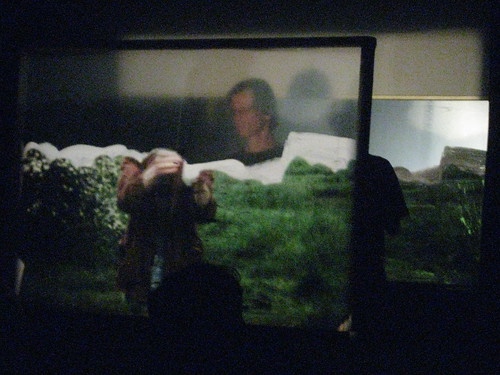
above: Guy Sherwin performs “Paper Landscape” in Brisbane during his recent screenings.

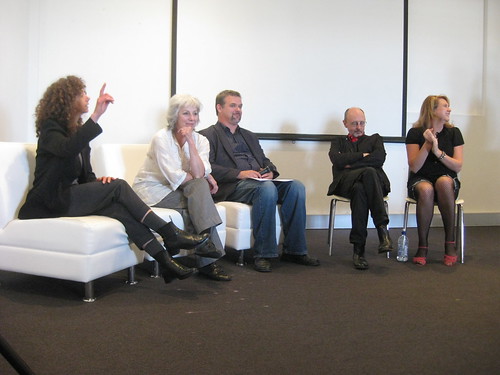
The TLC’s Louise and Lucas, joined by Sydney film maven Mike Leggett, recently made the trip to Brisbane to see Guy Sherwin and Lynn Loo do their thing at the IMA. Guy and Lynn’s trip was courtesy of the Brisbane Film Festival and our friends at Otherfilm.

It was totally worth the journey! Some more pictures from our adventure here.

In the meantime, listen to this radio piece with Guy on ABC Radio National, interviewed by Amanda Smith [15 min, 14mb mp3 file]

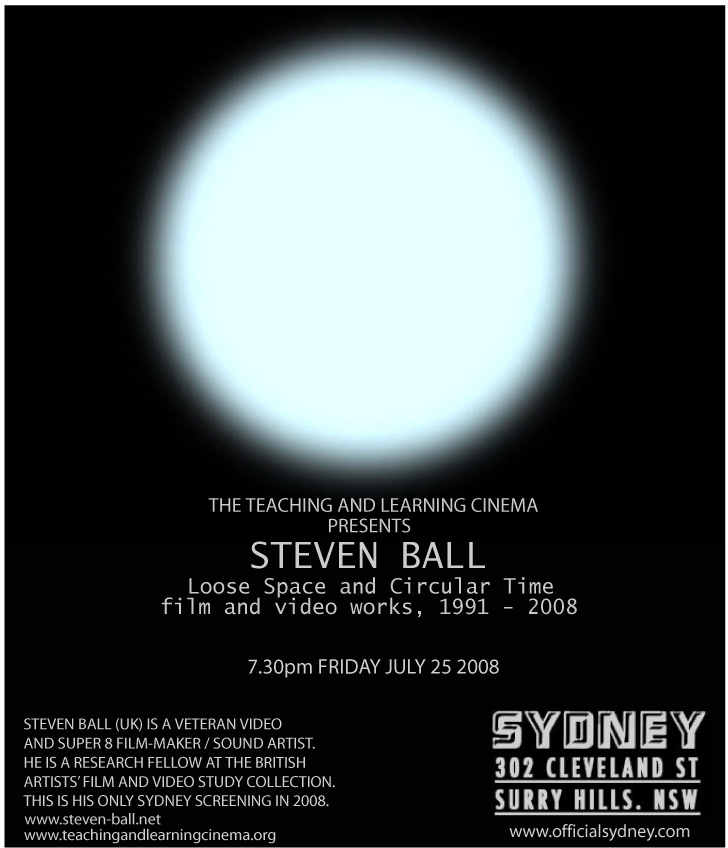
Steven Ball Screening in Sydney

steven ball flyer

Screening Details:
Loose Space and Circular Time
Steven Ball’s Mini-Retrospective
7:30pm, Friday 25th July 2008
SYDNEY
302 Cleveland St Surry Hills NSW
—Entry by gold coin donation—

UK film and video veteran Steven Ball will be in Sydney briefly next week. The Teaching and Learning Cinema is delighted to be presenting an retrospective of his film and video work produced during the last twenty years.

Lucas from the TLC first met Steven in 2003 during an Expanded Cinema research trip to London. Steven is a research fellow at the British Artists’ Film and Video Study Collection, and he helped dig through the archives to find documentation of film performances from the 1970s in London.

As it turns out, Steven actually spent a several years in Melbourne from the late 1980s, shooting and organising screening programmes with the Melbourne super 8 group. In London, he is one of the organisers of cogcollective, a group which curates grassroots screenings of experimental film and video work.

Steven has prepared a special programme for Sydney. You can view the whole programme in detail here.

We’re very pleased to see that the programme includes Super 8 films shot in Australia, some of which he has re-edited recently, drawing together fragments of small-gauge footage in a memory-montage landscape film: The Ground, The Sky and the Island (2008). Our screening event will be the world-premiere of this work!

Between the longer pieces, Steven’s programme is peppered with his “videoblog” experimental sketches from the series Direct Language.

On his visit to Sydney, Steven looks forward to engaging with local film and video makers, and he will be happy to discuss his participation in the many film and activist groups which he’s been involved in for many years.

Waiting To Turn Into Puzzles – film & music Wed 25 June 2008

An evening of music and film presented by Ensemble Offspring, Wed 25 June 2008 at the Chauvel, Paddington.

Waiting To Turn Into Puzzles is a new super 8 film work by Louise Curham featuring hand processed and hand-made film. Frames from the film have been scanned and printed, literally the ground for a new composition by Melbourne composer David Young for a performance by Sydney’s fabulous Ensemble Offspring.

‘WTTP is a cinematic experience with live music. Curham’s hand-processed, etched and looped super 8 films are simultaneously an intense visual experience and music notation for Ensemble Offspring. David Young ascribes a vocabulary of musical gestures to the textures, colours and shapes of the projections through a process of composition that explores the continuum between improvisation and notated music. David’s music has been likened to the ‘aural equivalent of seeing a world in a grain of sand’.

The evening commences with drinks in the Chauvel foyer with a screening of Bill Morrison’s ‘Light is Calling’ and is followed by more drinks in the Chauvel foyer.

7pm Wed 25 June
Chauvel Cinema, Paddington Town Hall, Cnr Oxford and Oatley Rd, Paddington
Tickets $35/20 bookingsl 1300 306 776 or www.mca-tix.com

8pm Thurs 26 June
Aphids Reel Music Festival
Australian Centre for the Moving Image, Fed Square, Melbourne
Tickets $20/15 bookings 03 8663 2583 or www.acmi.net.au

From this material, Louise scanned and printed frames of the film to create the ground for a score composed by Melbourne’s David Young. The work will be performed by Sydney’s Offspring Ensemble.

Mark Titmarsh Interviewed on Super 8 Film in Sydney

Between Super and Deluxe
Mark Titmarsh interviewed by Bob Percival, 1 August 2006

An in-depth interview with Mark Titmarsh, a key enthusiast for super 8 filmmaking in Sydney through the 1980s. Check it out here.

Bob Percival recently wrote a thesis on the history of the Sydney Super 8 Group. Read bits of it here.

PS – the above links no longer seem to be alive. However, while we try to locate those interviews again, read this

Chris Fleming on Long Film

9pm in long film
[above: the light at 9pm on Friday during Long Film For Ambient Light]

[The following is a short series of excerpts from an interview with Chris Fleming, recorded by Lucas, Friday 16th March 2007, 9pm. These quotes are cut from a longer conversation. You can also read a short note he wrote after the event, here.]

There’s something about the scale of it. When I first came in here I felt my eyes almost felt pulled on…because I’d been in my office all day… so it was really… I just kind of switched off…

LI: You’d said you were zoning oout?

CF: what does zoning out mean? Like a feeling that I didn’t know I was there but I knew I had been there. It’s really strange.

LI: how much time passed do you think in that period?

CF: five minutes? I don’t know.

Also this being framed by something that happened previously. It almost felt like an anchor. I found something vaguely comforting about the fact that something like that was being re-created.

The fact that it was done in the past lent it some weight?

CF – weight’s not the right word. Reassuring. It felt nice there was some continuity of tradition. Tradition’s not the right word, either, dignification. I really don’t know. My whole brain’s just switched off…

9pm outside long film
[continued, now outside the space]

It also felt a bit naughty coming in there…I was running out of the house. I’d been paralysed by wasting time, I could go in there and switch off without wasting time, there was a guiltless non-doing about it that I really enjoyed. The scale of it just shifts. The change in physicality. Like when you stand on somewhere really tall and you feel your stomach just move. That caused a shift in me that kicked something off, just the scale of it, it was big and enclosed, that was a defamiliarisation effect.

Anne Walton on Long Film

long film 2pm
[above: the light at 2pm on Friday during Long Film For Ambient Light]

[The following is a short series of excerpts from an interview with Anne Walton, recorded by Lucas, Friday 16th March 2007, 2pm. These quotes are cut from a longer conversation. The full transcript will be more interesting!]

I felt a smoothness… like I was entering into something very smooth […] the light has something to do with it. And all the grey tones in this place. […] A slightly clinical feel. […] I couldn’t help noticing the curtains. Some kind of notion of theatre. Although I quickly realised they were just here, already a part of the space. I felt myself a part of the structure. […] As far as this being an event […] the physical structure and the structure that you… that this event is… it resonates with the notion of intervals and spaces.

When there isn’t much that’s been put here, I start to want to look at what’s been put here already… The little dotted recesses… in the concrete…

I quickly felt some kind of a longing – to be here, for much longer. … It’s a long film, and I’m only here for just a quick glimpse. So I feel…regretful.

[If I stayed longer] I imagine some of the initial romance and positive feelings would start to be challenged…

I started wondering whether lots of conversations will happen – is it a social space? A meditative space? Conversation can be great way to pass the time.

I feel as though if I stayed here longer… I’d do a lot of writing… from a state of relative emptiness… not useful writing, just a flowing writing…

The lightbulb … it is very electric… the thingness of it is very strong… it is a very sharp point in the centre of the space. It’s really crackling…

The time chart and the statement – made me feel supported in being here… they’re a kind of explanation. It helps to frame the experience for me… and give…not clues, but it reinforces…particularly the long scroll…somehow preparatory for my time here…

It’s quite zen …very zen … just attending to the present moment … I can imagine, having been I’m going to go away and take it with me…a consciousness of this slice of time in the space has been carved out, and it’s here, and I entered it for a brief moment, it’s almost like I dipped my toe into a stream and when I go away I know the stream’s there and others are going to come to the spot that’s been carved out for getting right into it … immersion…

Louise was struck by the austerity of this…I said yes, although for me austerity has a harshness about it, I don’t feel yet… There’s more of a sense of generosity in this space…

I’m glad to see it at this time, when it’s still pristine and unspoiled by human … habitation …

Reel Rescues – Film in the Library

Our friend Sally Golding of Otherfilm is presenting this great programme up in Brisbane:

Reel Rescues at the State Library of Queensland

Reel Rescues is an exhibition of home movies, silent films and original newsreels, acting as a time capsule of Queensland life from the 1920s through to the 1970s in moving image form. The show is co-curated by OtherFilm’s Sally Golding (along with Bryony Nainby) and features Golding’s conservation work, with detailed studies of beautifully deteriorated film frames. Reel Rescues also features contemporary film works dealing the broader notion of ‘the archive’ by artists Jim Knox and Kerry Laitala, and a new sound piece ‘Sonic Projection’ by OtherFilm’s Joel Stern.

Reel Rescues, SLQ Gallery, Level 2, until Dec 2nd 2007. Free Entry.
http://www.slq.qld.gov.au/whats-on/exhibit/cur

expansive cinema at the agnsw

wim wenders film

passing along this info!

Programme at the AGNSW for all fans of experimental cinema
Saturday 16 June 2pm
Saturday 23 June 12noon
Saturday 7 July 12noon
Saturday 21 July 2pm
Domain Theatre, Lower Level 3

This series focuses on the enduring traditions and lasting influence of experimental and avant-garde filmmaking. This is so-called formalist cinema, using film in ways that are comparable to the aims of modern painting and sculpture, foregrounding the medium itself, emphasising the film strip, the frame, montage, projection, and even the chemical and technological processes. The rejection or subversion of Hollywood-type storytelling generates works with a loose or non-linear narrative, making unexpected dislocations of time and space, permitting personal explorations and poetic or ironic juxtaposition. Taken together, these journeys of colour and sound demonstrate the sheer dynamism of experimental cinema over the past 85 years.
Continue reading “expansive cinema at the agnsw”

Research on moving image art in Japan

Some information I have discovered while here in Yokohama:

MIACA – Moving Image Archive of Contemporary Art
http://www.miaca.org/english/news/index.html

Videoart Center, Tokyo
http://www.vctokyo.org/j/about/
(Japanese – Google for a web page translation Japanese to English)

Art Autonomy Network
http://www.a-a-n.org/top_e.htm

And for the Expanded Cinema heads, Jun’ichi OKUYAMA For example:

Cut-Off movie, 1969 16mm 9min. A film 9 minutes in length was cut in several places beforehand, those severed places covered with tree leaves and condoms and the like. When projected, naturally those places cause an interruption in projection, and the filmmaker himself explains why the accident occurred. This projection/ performance was first shown in 1969.
http://www.geocities.jp/okujun16/page016.html

Reference for history of Japanese experimental film – 2004 film program at the Pacific Film Archive, LA
http://ieas.berkeley.edu/events/2004.10.19-26.html