When: Saturday 20 September, 6.30-8pm
Venue: Drill Hall Gallery, ANU Canberra
Attendance is free, bookings required: Register here
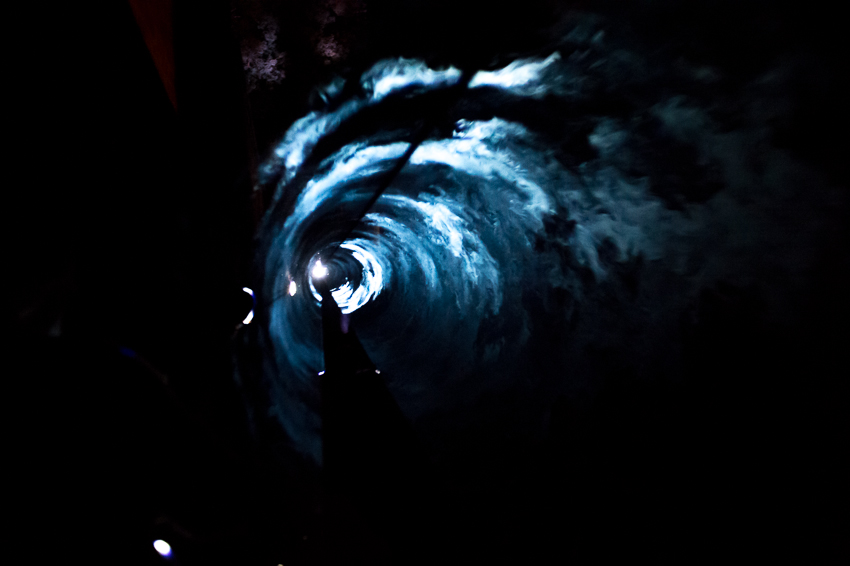 [Anthony McCall’s Line Describing a Cone (1973) presented at CEMENTA Festival in Kandos, 2015. Photo by Alex Wisser]
CONE + BULB – an evening of landmark Expanded Cinema is a presentation by Australian artist group Teaching and Learning Cinema (Lucas Ihlein and Louise Curham). Closely aligned with the Drill Hall Light Source exhibition’s focus on the technologies of cinema projection, we offer two groundbreaking works from the early days of the London Film-makers Co-op.
Anthony McCall’s Line Describing a Cone (1973) shifts our experience of cinema – from a two-dimensional image on a flat screen, to an illuminated cone occupying three-dimensional space. The work begins as a single point of light (made visible by non-toxic smoke from a haze machine). Gradually a sculptural form emerges, invoking Roland Barthes’ image of cinematic projection as a “dancing cone which pierces the darkness like a laser beam.” Audience members take great delight in interacting with this emerging “solid light object” over the work’s 30 minute duration.
Malcolm Le Grice’s Castle I (1966) uses light and projection in inventive and illuminating ways to disturb traditional notions of the screen. Known affectionately as “The Light Bulb Film”, Castle 1 combines found footage and sound with a solitary light bulb suspended directly in front of the screen. At intermittent points during the film, the light bulb is switched on, obliterating the projected image and illuminating the entire room. This is one of the earliest examples of expanded cinema, where the space of the cinematic projection, and the audience’s experience, are folded into the artwork itself.
CONE & BULB is a rare opportunity to experience expanded cinema under the guidance of Teaching and Learning Cinema (Louise Curham and Lucas Ihlein). For more than 20 years, TLC’s creative project has centred on making historical Expanded Cinema performances available for audiences to experience in the present. Their work is immersed in archival research, oral history, and inventive re-enactment, and seeks to promote the survival, continuity, and longevity of embodied live art. TLC’s current project experiments with synthetic DNA as a medium for long term data storage, using Malcolm Le Grice’s expanded cinema piece Horror Film 1 (1971) as a case study.
CONE & BULB program:
6:30pm-8pm
Introduction by Louise Curham and Lucas Ihlein from TLC
Castle I (1966) by Malcolm Le Grice: 16mm film projection (sound), with intermittent live flashing lightbulb. (9 minutes)
Short break
Line Describing a Cone (1973) by Anthony McCall, 16mm film projection (silent), with haze machine (30 minutes).
Informal discussion and a cup of tea with TLC.
Audience members should note that this event includes an intermittent bright flashing light, and a room filled with non-toxic haze. Please get in touch if you want to discuss accessibility and health concerns.
Films included in this event have been generously loaned by LUX, London (formed as a continuum of the London Filmmakers Co-op).
More info: see https://teachingandlearningcinema.org/


Cone and Bulb encountered some technology challenges, especially getting audio for Castle 1. But with some help from expanded cinema luminary Sally Golding, we were able to trouble shoot effectively and the sound worked well enough given the limitations of a contact printed optical sound track in the original. A 15 year old audience member said the light bulb flashes were a bit intense, but he sat through it. Another audience member identified morse code for SOS in the light signal. There was much discussion by Lucas, me and our colleague Jo Law about the light bulb flash. Steven Ball chimed in with some useful messages – the one that sticks in my mind is ‘it was the ’60s! Of course there’s no instruction’. Lucas’ research showed a wide range of timing options for Castle 1 from 9 mins to 22 mins. We believe this is partly to do with where Malcolm chose to put the credits and the fact that from about minute 12, the film is clear leader with soundtrack, that’s a whole ten minutes of film with no image. We were also surprised to find no documentation on the internet for Castle 1 so here’s ours – you’ll see we went for about 14 minutes https://vimeo.com/1121342562
Here are notes from our friend Benedict Moleta, who attended Cone and Bulb:
—
I was glad to attend Cone and Bulb, an evening of expanded cinema presented by Teaching and Learning Cinema (Lucas Ihlein and Louise Curham) at the Drill Hall Gallery, Australian National University, on Saturday evening September 20, 2025.
Two films were shown on the night; Malcolm Le Grice’s Castle I(1966) and Anthony McCall’s Line Describing a Cone (1973).
I was unfamiliar with this tradition of experimental filmmaking, associated with the London Film-makers Co-op, and appreciated the introductory remarks from Curham and Ihlein, connecting the works to English and Australian film movements, and explaining their work over the past twenty years in bringing screenings of experimental film to venues and audiences across Australia.
Both works involved expansion beyond the flat surface on which the image was projected. In le Grice’s film this involved an intermittently flashing light bulb, that dangled in front of the projected film, which itself included images of an intermittently flashing lightbulb, interspersed with semi-repetitive news footage and sound track. It was pleasantly abrasive.
In the McCall film, shown in a blacked-out side gallery, a single line of light slowly described a large circle on the gallery wall, thrown from the projector. Over the course of half an hour, and gradually becoming apparent to audience members spread around the room, the projector’s beam became an increasingly tangible cone of light, in which audience members found they could wave their hands, hold up a wine glass, or stare into from one end of the room to another. The experience was of light and image becoming visible, and drawing viewers into the emerging luminescence. Dry ice was puffed into the room to accentuate the visibility of the light beam.
For a newcomer to this work it was an evening of being drawn into two artists’ expansions of the aura cinema.
But perhaps even nicer was being involved in Curham’s and Ihlein’s unfussy combination of presenting works from the past, preserving the excitement of experimentation which motivated the genesis of those works, and sharing their enthusiasm with a crowd of Canberrans and others, who came along to watch and feel the light.