We recently received an email requesting advice on how to make a users manual for the re-enactment of a historical artwork.
here are a few notes…
Continue reading “A draft manual about making manuals…”
Louise Curham and Lucas Ihlein – Australia
We recently received an email requesting advice on how to make a users manual for the re-enactment of a historical artwork.
here are a few notes…
Continue reading “A draft manual about making manuals…”
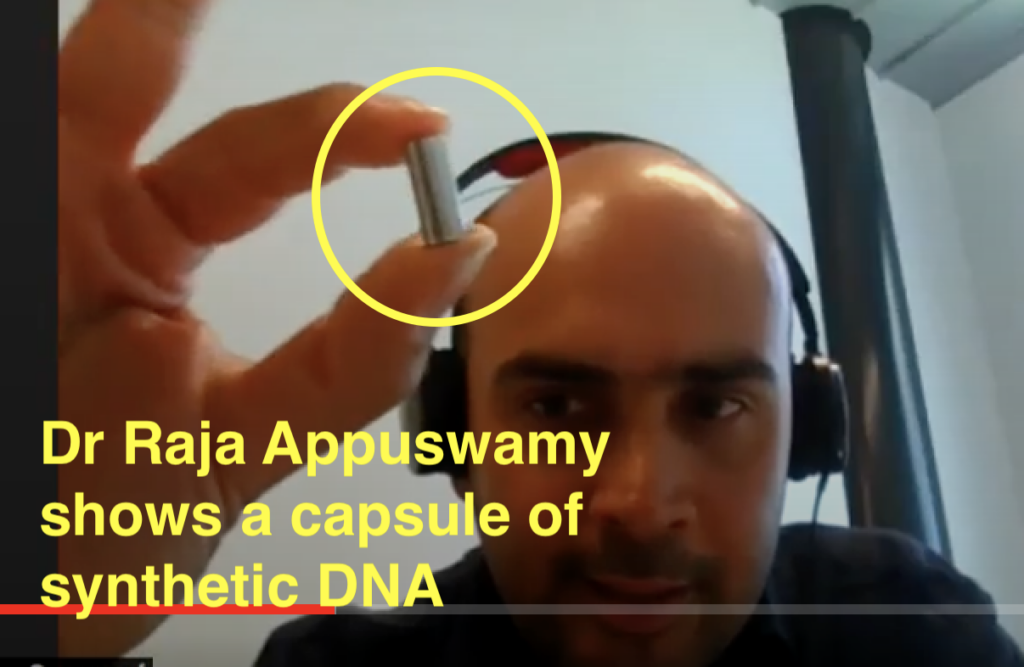
Raja and I (Louise) met back in 2021 when I chaired a panel he was in at iPRES. Our session was online and we had time to chat beforehand. I’d read up about his paper on DNA storage. I knew something about this because I saw a great presentation about it from former National Film and Sound Archive director Jan Muller. Muller loved DNA storage and he organised for Cathy Freeman’s Olympic win to be stored on DNA and then decoded from that source for display on the Opera House sails in Sydney. I don’t have specific dates for this work but it was in the period around 2016.
Somehow I discovered Raja was looking for a “use case” from cultural heritage to show the potential of DNA storage and that’s how we began a dialogue about the work Lucas and I have been doing with Malcolm Le Grice to make a user’s manual for Horror Film 1 (building on our project Wo(Man) with Mirror with Guy Sherwin, and lessons from work with Lynn Loo on Autumn Fog).
Fast forward to Feb 2023 and Raja was ready to actually encode some content on DNA. What went in there? Here’s a screenshot from the Dropbox that Raja used to store all the final content:
Continue reading “What’s in the DNA capsule for ‘Horror Film 1’?”

I (Lucas) am thinking about the provocation of sending info 1000 years into the future in the synthetic DNA capsule.
This provocation emerges from our collaboration with Raja Appuswamy, a data scientist at Eurecom in France, who is storing our Horror Film 1 Users Manual and associated documentation materials on synthetic DNA.
Raja is working with our project as a demonstration of a ‘use case’ for synthetic DNA storage – the idea is that items of intangible cultural heritage (like Horror Film 1) can be sent into the future as an act of preservation, or archiving.
Continue reading “The Provocation of Synthetic DNA”
Here’s a paper that we recently presented in Meanjin Brisbane for the 2024 ISEA conference (International Symposium on Electronic Art). We presented as part of the 4th Summit on Media Art Archiving.
It’s called “Re-enactment, Users Manuals and DNA Storage: methods for media art preservation”, co-authored by Louise Curham, Lucas Ihlein, Raja Appuswamy.
About the authors:
Louise and Lucas are Teaching and Learning Cinema (TLC), and Raja is a data scientist in France at Eurecom.
The paper is really just a brief intro to the project we’re working on at the moment.
Abstract
This paper discusses a novel approach to media art preservation led by Australian artist-archivist group Teaching and Learning Cinema, using the field of expanded cinema as a case study.Works of 1970s expanded cinema (which combine celluloid film projection with live performance) are typical of the inherent “lossiness” of much 20th and 21st century media art. While offering richly embodied experiences in their moment of enactment, expanded cinema’s ephemerality means that it risks falling out of circulation and thus becoming unavailable for future experience. Teaching and Learning Cinema, over the past 20 years, has evolved a methodology for preserving works of expanded cinema, featuring three overlapping approaches. First, intergenerational transfer is attempted: in this phase, younger artists learn about the work from its originators, and produce live re-enactments. During the second phase, a users manual is assembled, encoding the artwork as a set of instructions with the intention of making it available for future generations of performers and audiences. Thirdly, the archived material from phases one and two is stored on synthetic DNA, with a view to transmission into the deep future (perhaps 1000 years). While the first two phases are urgent, preventing the work’s immediate extinction, the third phase is speculative, broadening the enquiry to explore the question of cultural heritage across much longer
timeframes.
Keywords
Media art preservation; time-based art preservation; archival practice; preservation; DNA storage; manual making; expanded cinema; re-enactment; media art history.
This week we lost a VIP in the experimental cinema community. Peter Mudie was a teacher at University of Western Australia, where I studied fine arts in the mid-1990s. Shortly after he arrived in Perth (from Canada via London) he set up a Super-VHS editing suite, and began teaching the history and practice of experimental film and video. It was a revelation.
Each week we would watch films from the canon, dating back 100 years, right up to the present. Often Peter had obtained celluloid prints on 16mm, and he would lace the projector up in front of us, cigarette dangling from his lips. His drawling, chuckling style of teaching, infused with marxist politics, was infectious.
Continue reading “Farewell Peter Mudie”
As we finalise an article about the manual for Horror Film 1 and the potential to use DNA as a storage medium for the manual versions and additional components, we have gone looking for literature about manuals.
I (Louise) have learnt that making procedures is called ‘procedural discourse’. David Farkas writes about this back in 1999. It is about ‘written and spoken discourse that guides people in performing a task-in other words, it is “how to” communication.’ His article aims to set out what makes a procedure a procedure, he sets out the relationships, and persistent logic in making procedures, as he describes it. Here’s a short summary – we’re in the territory of purposeful human behaviour – people wanting to get stuff done, usually around a quite clearly defined goal. He defines getting stuff done more eloquently – he calls it accomplishing tasks and he clarifies that actually means changing things.
Continue reading “What scholars of manuals have to say”
Louise and Lucas from TLC have been working towards various versions of a users manual for Horror Film 1 (1971). In this blog post, we’ll share a few versions of the manual, which are still at an early stage.
Continue reading “Horror Film 1 – Users Manual (version 1.0)”
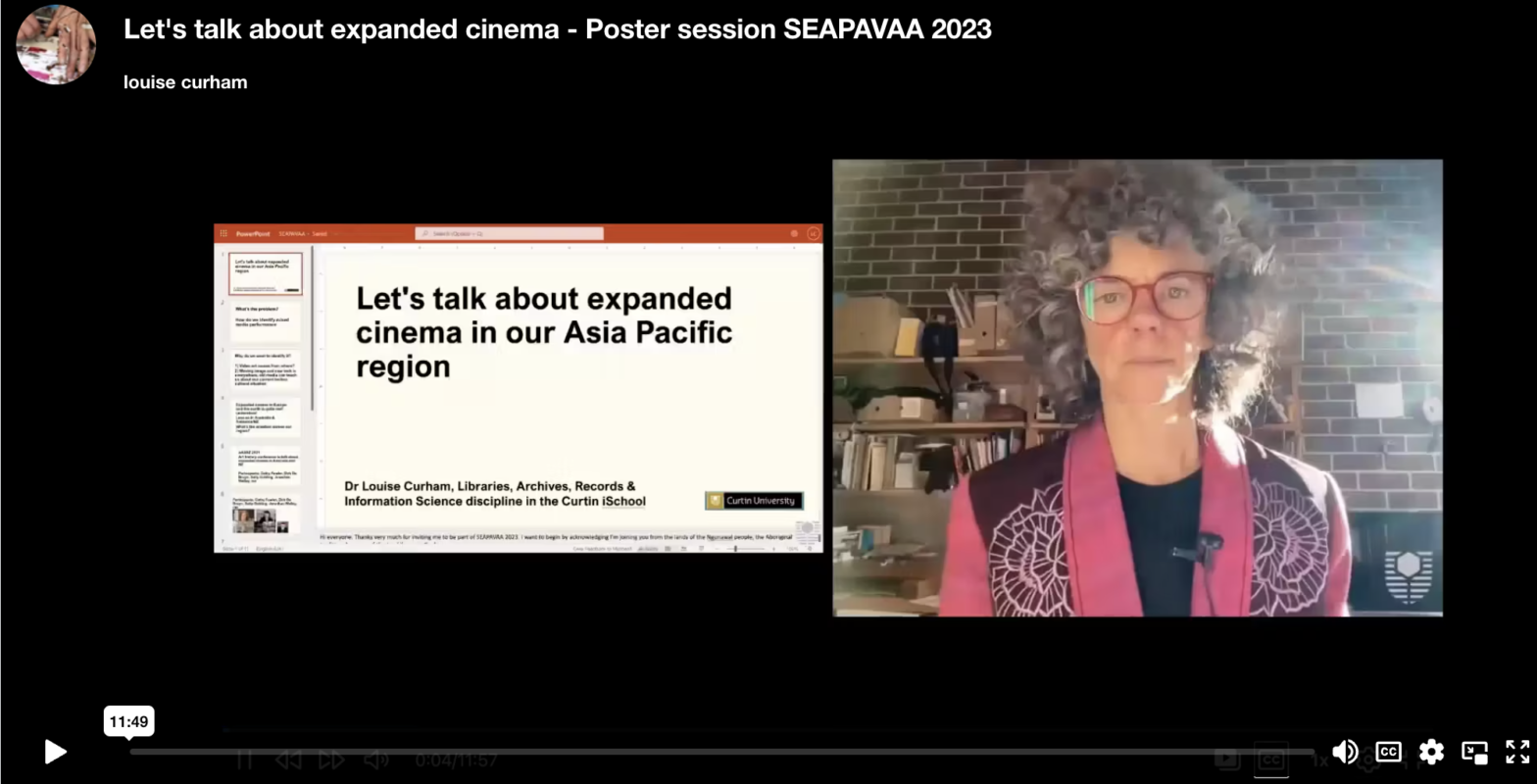
Dr Louise Curham from Curtin University’s iSchool starts a dialogue with audiovisual archivists of South East Asia about expanded cinema.
Here’s the recording of this talk:
And here’s what I say (not quite identical but pretty close)
Hi everyone. Thanks very much for inviting me to be part of SEAPAVAA 2023. I want to begin by acknowledging I’m joining you from the lands of the Ngunawal people, the Aboriginal traditional owners of this land I’m on in Canberra.
Continue reading “Let’s talk about expanded cinema – Poster session SEAPAVAA 2023”The old Antics Hair Salon in Canberra will come to life again in January and February 2023 as Canberra’s newest microcinema.
What: film screening/film performance event
Where: 8 Petrie Plaza, Civic, Canberra
When: 8-930pm Sat 14 Jan
Tickets: $10 donation
Over the past couple of years a group of Canberra artists interested in projection, reflection and moving image have gathered on and off and worked together in different constellations. Join us for screenings at 10 Petrie Plaza (opposite Ted’s Photographics) in Civic in the shop front that was Antics Hair’s final location.
On Sat 14 Jan, join Rowena Crowe from Wollongong, current lead of Sydney’s artists film lab, Workshop for Potential Cinema and local artists Caroline Huf and Louise Curham. We will screen new works originated in 16mm and super 8, some shown on these gauges, some digital.
Continue reading “Antics Hair Microcinema”