Tomorrow Sun 4 April, there will be a performance of Malcolm Le Grice’s Horror Film 1 at the Courtisane Festival in Belgium. (Aside: I see a program by Audrey Lam of the work of Corinne and Arthur Cantrill was shown by Courtisane last year – great to see, I’m not aware of it travelling widely in Australia unfortunately).
Cinzia Nistico has worked with Betija Zvejniece for the last few years making performances. This time Betija is making this performance supported by one of Courtisane’s 2026 curators, Erwin van ’t Hart. It’s in the program Chronochromatic Measures 2. Erwin is the curator of the program in collaboration with LABO BxL?—?artist-run filmlab in Brussels.
On page 101 of the Courtisane program, you’ll find Betija and Horror Film 1 https://www.courtisane.be/sites/default/files/Catalogus%202026_BW_mail.pdf
[Here is another link to the Courtisane Catalogue]
In 2013 Lucas and I visited Malcolm in Devon. He gave us an audio file on CD of a breath track. My recollection is that he told us he used this recording sometimes, he created the breathing track quite a few different ways. What he was clear about is that the breathing comes in before the performer starts, he used the breath track to get in the head space to perform. Erwin is very keen to use Malcolm’s track for tomorrow’s performance so find the link below.
So what is the digital preservation/digital curation conundrum? The title in the metadata of the track is nothing to do with the breath track! The CD is clearly labelled on the outside but when I open up the file, the metadata reports that the author is Andrzej Sledz on an album titled ‘Wywieranie wplywu na ludzi’ English translation ‘Influencing people’, year 2006. I recollect Malcolm telling us nothing about Andrzej nor anything about this file title. The internet does tell me Andrzej is a filmmaker but there’s no obvious connection …
Here’s a screenshot:
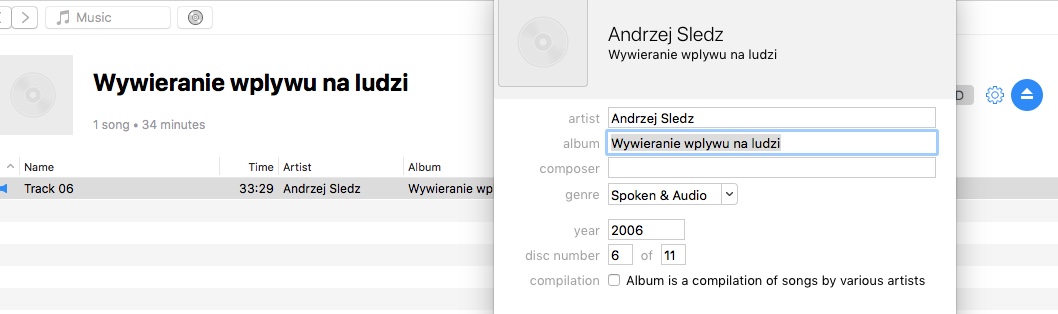
The good news is that when I play the track, it’s Malcolm’s breath track.
Below is the track and I’ll leave some things here for Erwin:
- Here’s the user’s manual link
- Here’s the ‘users log book‘ to leave a note about how it all went, tips and tricks for the next performance/performer/curator
Breath track here on Soundcloud https://soundcloud.com/lcurham/horror-film-1-breathing-track (unfortunately, I can’t upload the AIFF-C into WordPress)
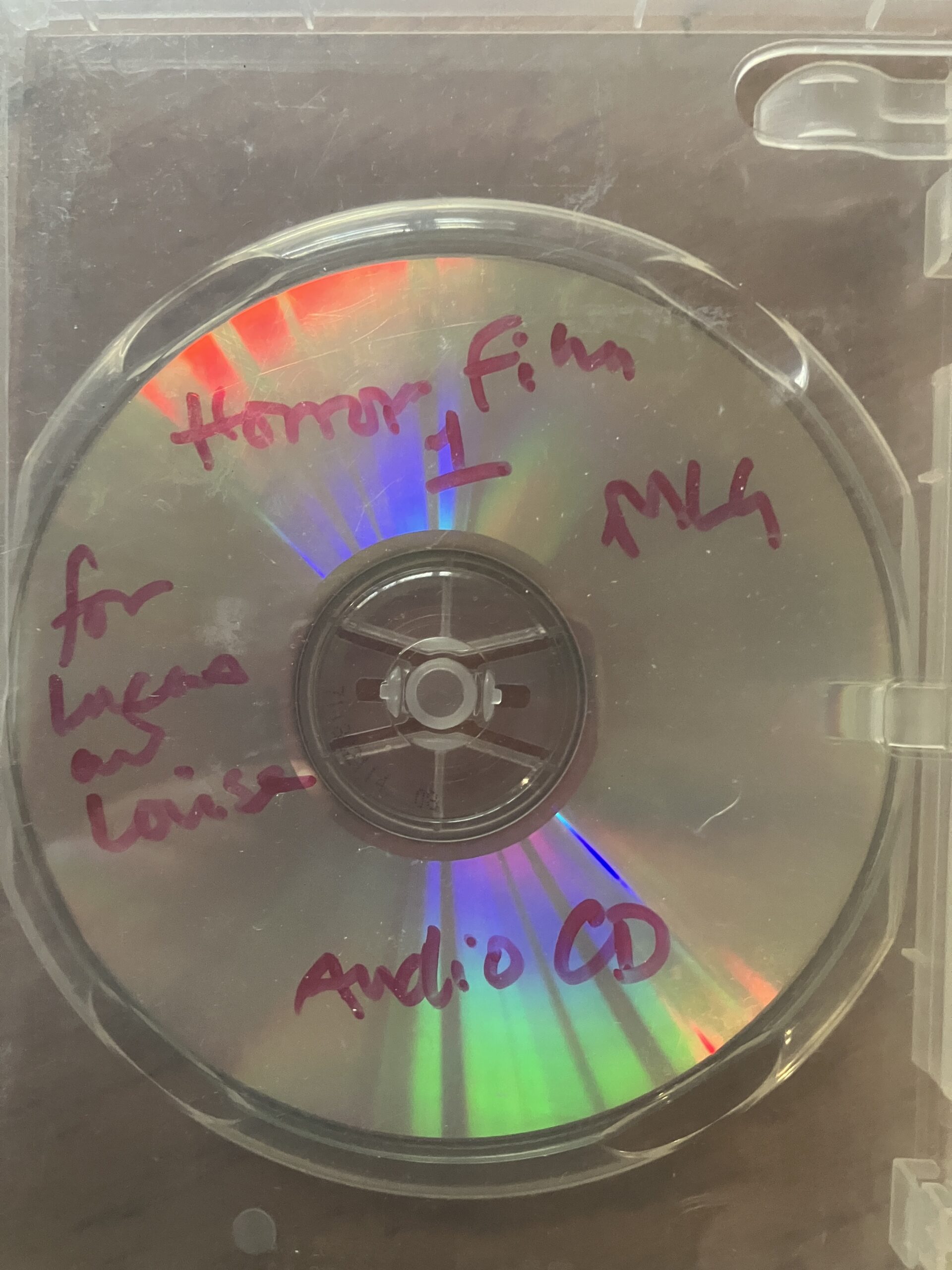


Thanks Louise for uploading that soundtrack.
The Artist’s Breath!
I seem to remember Malcolm saying the breath recording was transferred from an original audio tape to this CD – am I right? Noting also that the recording goes for 33 minutes – longer than the performance itself – meaning there is plenty of ‘extra time’ for the breathing to carry on in the space before the performer starts moving.
Looking back into the interviews we did in 2013, here’s an observation from me, and a reply from Malcolm:
…so here we have “classic” Malcolm: the breath audio was recorded by Malcolm (in the 1970s?), its audio quality happens to be a bit rough (“wind interference” – probably the sound of the air from Malcolm’s breath interfering with the microphone?) – but according to Malcolm, the audio’s roughness is not “essential” …and Malcolm immediately gives permission for re-enactors to re-make the breath track themselves.
This is also a nice part of the discussion relating to the role of the breath in the performance ritual:
As someone who has performed the re-enactment of this work, I can identify with Malcolm here. The technical set up of the work is always a bit difficult – different rooms, different equipment, setting up the loops, the projectors can be temperamental. At a certain point, the performer needs to “settle” and go a bit “internal”, which means forgetting about all the technical stuff and being present and embodied. Here we can see that playing the breath track into the room assists the performer to feel settled. There is an alignment between the breathing on the audio, and the performer’s own breathing which assists with this process.
Today, I am really doubtful this comes from a 70s recording. I will ask the brains trust at my house if they can hear any qualities in the recording that give the game away it’s recorded on reel to reel. I’ve been sitting here listening to it for a while and at one point I think I hear the audience start clapping just for a beat. Then the breath goes on again. This along with the strange metadata tells me this might have been a more recent thing …